
Nvidia Shares Fall Following Microsoft’s AI Chip Unveiling
Nvidia and AMD shares fell following Microsoft's unveiling of the Azure Maia 300 artificial intelligence processor, which is designed to reduce Microsoft's reliance on external hardware and boost AI rack efficiency.

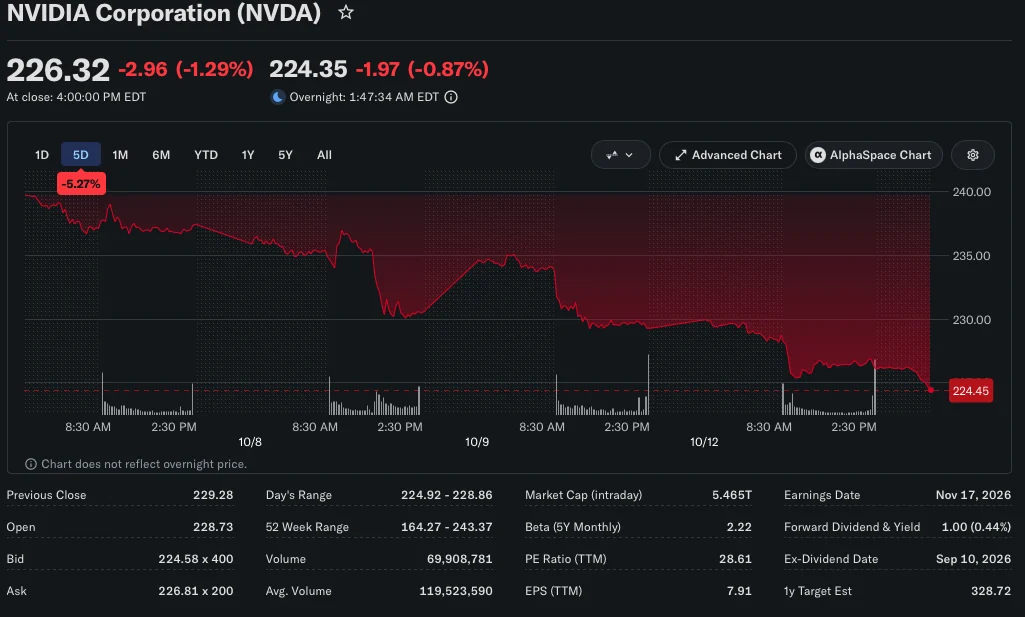
Nvidia (NVDA) shares experienced a downward shift, finishing Monday, October 12, 2026, down 1.29% (2.96 points). The downward trend continued in after-hours trading, with the stock dropping an extra 0.87% (1.97 points). This recent retreat in Nvidia’s (NVDA) valuation follows Microsoft’s (MSFT) unveiling of its newest artificial intelligence processor, the Azure Maia 300, a development designed to decrease Microsoft’s dependence on both Nvidia (NVDA) and Advanced Micro Devices, Inc (AMD).
Nvidia Stock Price Dip: Will Microsoft’s AI Chip Further Pull NVDA Down?
Alongside Nvidia (NVDA), AMD equity values also suffered declines. AMD shares finished Monday down 2.28%, followed by a further 1.46% drop during after-hours sessions. Conversely, Microsoft (MSFT) experienced upward momentum, posting a 1.14% increase at Monday’s close and an additional 0.18% rise in after-market trading.
These market shifts stem primarily from the announcement of Microsoft’s new AI processor. Previously, the tech giant relied heavily on hardware from Nvidia and AMD. Introducing the Azure Maia 300 processor positions Microsoft to achieve self-sufficiency, a transition that could deal a significant blow to both Nvidia and AMD.
Additionally, Microsoft reported that the Maia 300 delivers 40% higher tokens per megawatt compared to alternative GPU-driven architectures. Greater token output per megawatt results in heightened AI rack efficiency. Currently, the Maia 200 chip supports Microsoft production workloads like Microsoft 365 Copilot, alongside OpenAI models, Microsoft’s MAI models, and various open-source models. The expanding portfolio of models managed by Microsoft presents a potential challenge to Nvidia’s market leadership. Furthermore, other businesses might emulate Microsoft’s strategy to lessen their dependence on existing industry titans.
Also Read: Stock Market Crash Warning as Valuations Echo the Dot-Com Bubble
Even so, Nvidia and AMD maintain pivotal positions within the data center and artificial intelligence semiconductor sectors. Wall Street maintains an optimistic outlook for both companies, anticipating robust revenue figures and strong earnings per share.
Frequently Asked Questions
Why did Nvidia’s stock price drop on Monday, October 12, 2026?
Nvidia’s stock declined following Microsoft’s public reveal of its new Azure Maia 300 AI chip, which is intended to reduce Microsoft’s reliance on Nvidia and AMD hardware.
How did AMD and Microsoft stocks perform in the same trading session?
AMD shares also dropped, closing 2.28% lower on Monday and losing another 1.46% in after-hours trading. Meanwhile, Microsoft stock rose 1.14% at Monday’s close with an additional 0.18% gain after hours.
What are the efficiency benefits of Microsoft’s new AI chip?
Microsoft stated that the Maia 300 processor provides 40% more tokens per megawatt than alternative GPU-based systems, leading to a more efficient AI rack.
What workloads are powered by Microsoft’s existing Maia chips?
The Maia 200 chip powers Microsoft production workloads including Microsoft 365 Copilot, OpenAI models, Microsoft’s MAI models, and several open-source models.
What is Wall Street’s current stance on Nvidia and AMD?
Wall Street remains bullish on both Nvidia and AMD, anticipating strong revenues and earnings per share as they continue to play a major role in the data center and AI chip market.
Comments 0 responses